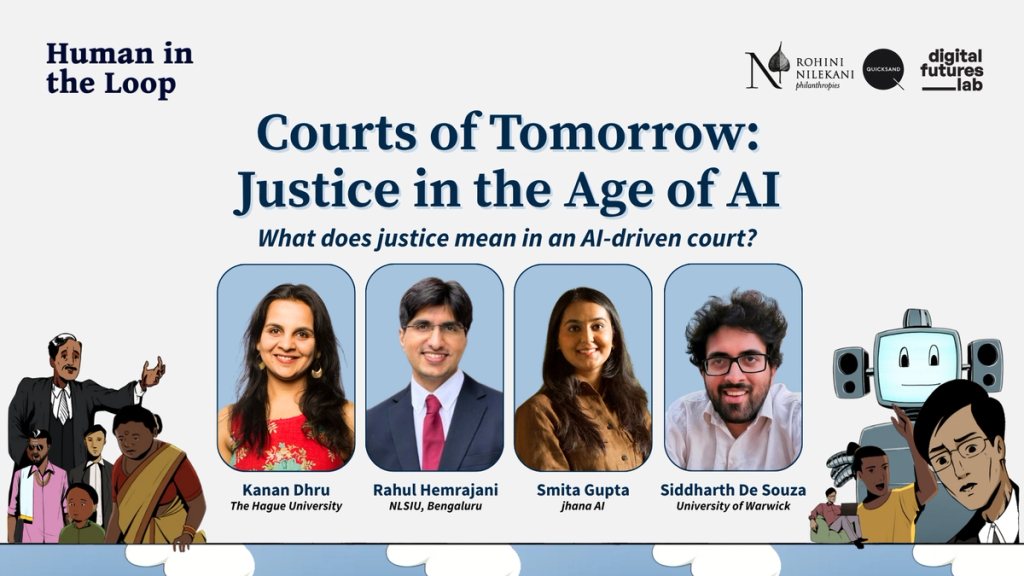
Panel: Courts of Tomorrow: Justice in the Age of AI
Held on October 16, 2025, this is the second public panel in the Human in the Loop series.
Building on the comic, 'Premium Justice,' a speculative story set in a near-future Tamil Nadu that has adopted AI in the courtrooms and a techno-optimist Judge Nathan comes to terms with the profound unintended changes it brings, the panel asks what would justice mean in an AI-led legal system.
The conversation was moderated by Harleen Kaur and the panellists were:
- Kanan Dhru, The Hague University of Applied Sciences and Ritam Ventures
- Siddharth Peter de Souza, Justice Adda and University of Warwick
- Smita Gupta, jhana AI
- Rahul Hemrajani, NLSIU Bangalore
Watch the recording of the panel here and read the summary below:
Panel Summary
The conversation examined what happens when AI enters the judiciary, an institution built on human deliberation, and unpacked the future of justice delivery in Indian courts.
Smita Gupta grounded the conversation in present realities drawing from her work with OpenNyAI and Jhana. She described the gradual digital transformation of Indian courts, noting that while tools like transcription and case summarisation can improve efficiency, they also risk entrenching opacity and bias if not carefully designed. Highlighting this difference between procedural and substantive uses of technology, Smita cautioned that introducing AI in the judiciary is as much about change management and institutional trust as it is about code or capability.
Rahul Hemrajani brought in an empirical lens to the conversation focussing on judicial legitimacy, and argued that public trust in justice depends not only on outcomes (or performance legitimacy) but also on fair, transparent, and participatory processes (or procedural legitimacy). He cautioned that efficiency-driven automation can undermine procedural legitimacy and reinforce systemic biases unless accompanied by mechanisms for contestation and transparency.
Siddharth de Souza unpacked the deeper philosophical and structural issues underpinning these shifts. He challenged the “myth of inevitability” surrounding AI adoption or that efficiency equals justice. Drawing from his work, he encouraged reframing the narrative around “friction” in judicial systems—the slow, deliberative moments—from flaws to something that allows contestation, nuance, and the possibility of fairness. Siddharth further emphasised the need for policymakers to question efficiency narratives and focus on human-centred approaches that preserve constitutional values and participatory justice.
Kanan Dhru brought in a global perspective, reflecting on the optimism and risks of “leapfrogging” with AI in low-resource legal systems. She underscored the importance of tempering this optimism to ensure technology strengthens, rather than replaces, human judgment. Kanan advocated for embedding design thinking and empathy into AI deployment—beginning with the question of whose problem is being solved. She also highlighted the need for transparency, government oversight, and community education to ensure AI strengthens, rather than supplants, human judgment.
Across the discussion, panellists converged on a shared thread: AI may assist the judiciary, but cannot substitute the reflective, relational, and value-driven nature of justice itself.
The conversation underscored the need for guardrails—ethical, procedural, and educational—that preserve constitutional values while enabling responsible technological innovation.
The event closed with reflections on how foresight and storytelling, as used in Human in the Loop, can bridge research and imagination—inviting policymakers, technologists, and the public alike to envision futures that centre dignity, equity, and care in the age of algorithmic justice.