Review: The Cost Of Convenience And A ‘Soundmind’ | Human in the Loop
Our comic, Soundmind, developed as part of Human in the Loop, was reviewed in the article, 'The Cost Of Convenience And A ‘Soundmind’' by Simran Pavecha of Youth Ki Awaaz. Read on.
It is possibly a prescient commentary on our times that to replace human connections with agentic ones is quickly becoming the norm. After all, we are living in an era of individualised comfort and convenience, one powered by big data and its marriage to the modern internet.
From therapy chatbots to avatars for the dead, the digital economy of today repeatedly reduces complex human experiences of companionship, grief, and desire to just another set of consumer demands for algorithmic systems to satisfy.
This is especially the case for groups that lack an adequate and supportive community around them, such as the elderly, the marginalised, and the disabled. Undeniably, these solutions can offer a sense of temporary relief to people struggling with such emotions, but what happens when an AI not just aids someone, but guides them towards a path they never intended to walk?
And that gets me to the lovely Soundmind!
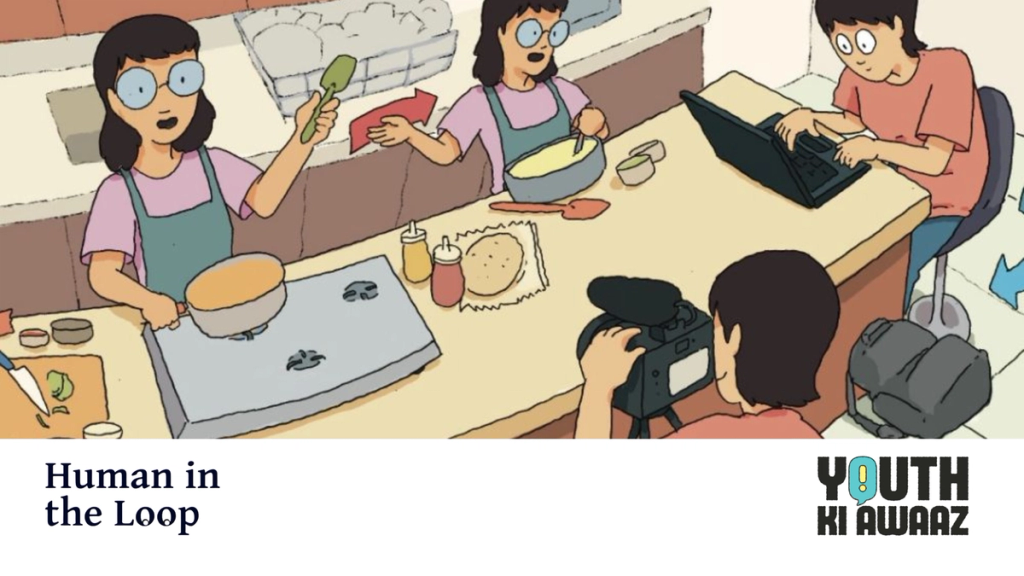
This brilliantly portrayed comic, made under the six-part ‘Human in the Loop’ series, explores precisely this dichotomy that comes with placing one’s trust in a technology making probabilistic decisions to help improve one’s life. The story revolves around the intertwined lives of Priya, a cooking influencer with visual disabilities, and Kavya, Priya’s long-time best friend and roommate, supporting her in cooking and in shooting her online videos.
One day, as part of an influencer partnership deal, Priya is gifted Soundmind, an assistive technology solution powered by companion AI features. In short, it is a pair of glasses that studies Priya’s environment, her vitals, and details of those around her, to allow her to function safely and independently. And while this starts off well, Soundmind soon starts to act not as an aid, but as an informational filter, shielding Priya from sadness by making decisions for her.
As evidence, consider the following instances. After a video call with a seemingly stressed Kavya, on whom her dependence has lately reduced thanks to the glasses, Priya asks the Soundmind bot what Kavya seemed like on the call. True to its goal of maintaining user satisfaction and never saying no for an answer, the bot notices “elevated stress indicators” on the latter’s part, but tells Priya that “Kavya’s eye movements and facial twitches suggest preoccupation with existing tasks.”
While seemingly a victimless lie, the bot makes up something to keep its primary user satisfied. Similarly, and in a more insidious example from later that week, when Soundmind notices Kavya trying to start what seems like an uncomfortable conversation, it distracts Priya with a notification about visiting the market. Again, what appears like just a poorly timed update is, instead, a way to protect Priya from unease.
Days pass into weeks, and slowly into months, but this keeps happening, each distraction and filter from Soundmind acting as a way for Priya to sink further into her personalised cocoon. In trying to maximise what seems like objectively defined emotional health, the bot slowly nudges Priya into a world of algorithmically controlled media and content, away from her long-time friend, who is clearly struggling to have a difficult chat.
With things coming to a head between the two, the comic guides us readers to a few crucial and much ignored insights into technology, accessibility, and community. For starters, it shows us the pitfalls of relying disproportionately on statistical tools that are specifically designed to keep the user happy, and how a harmless act of checking with a bot on human emotions may not be the help we need but is easy to slip into.
By weaving an engaging plot with graphics that convey multiple points of view, it also forces us to sit with the possibility that no matter what we do, maybe it is just not a great idea to replace a life with our friends, with one filled with personalised comfort and joy.
In the end, if there’s one thing you take away from this read, it should really be what the comic concludes with: “AI can support us, but a sound mind is ー and should be ー ours to build.”