Putting Workers First: Anticipating the Impact of Generative AI on the Creative Industry in India
When the ending of Raanjhanaa was altered without consent using generative AI, it wasn't just a controversy; it was a signal. Across India's creative industries, AI is quietly reshaping how content is made and whose labour is recognised, valued, or made invisible.
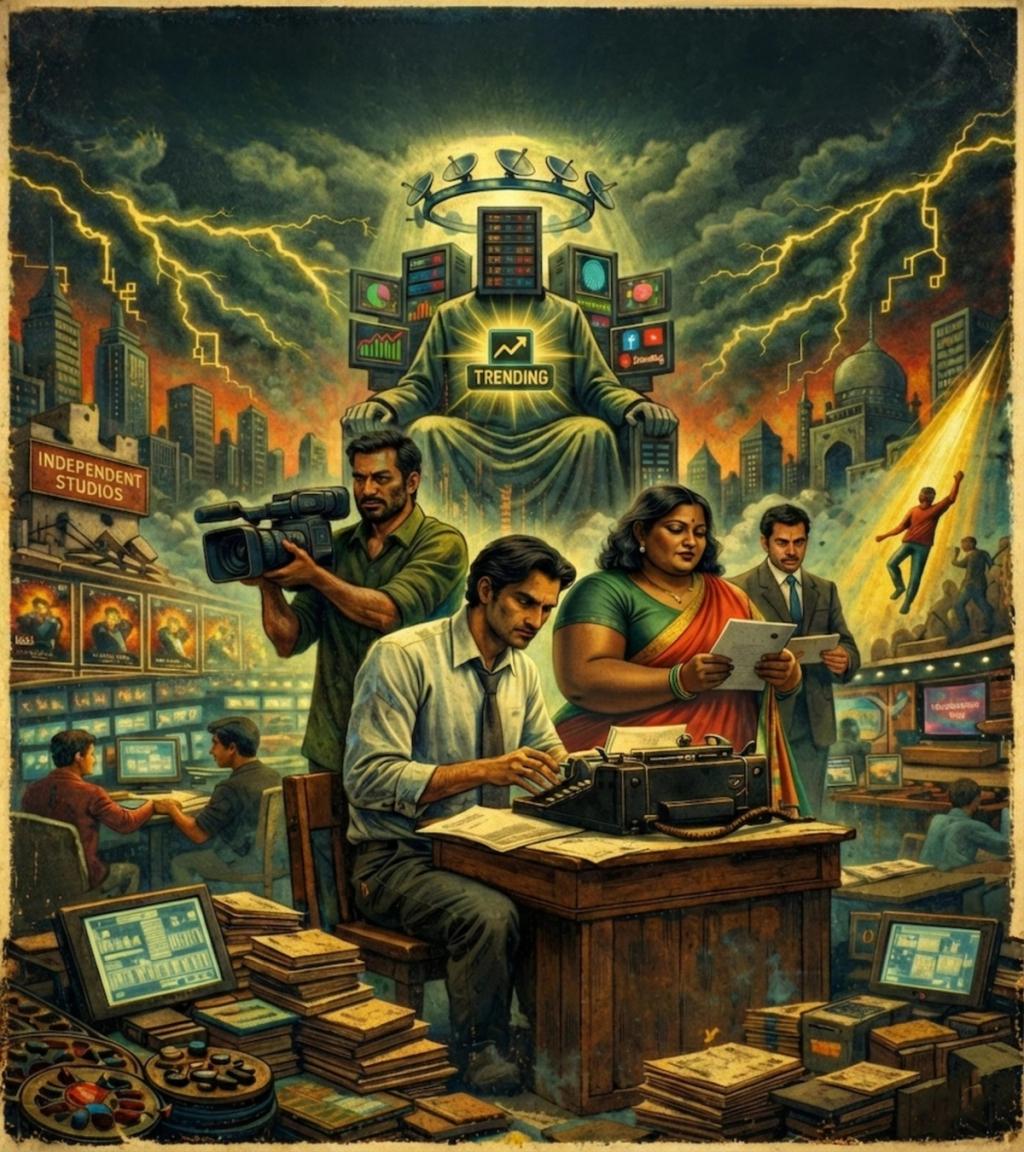
AI is already reshaping film and media production, from script analysis and VFX to dubbing, storyboarding, and marketing. Yet even as these technologies advance, the workers who sustain India’s creative economy, junior editors, voice artists, light and spot workers, set designers, are left without a clear path forward for how their roles will evolve, what new skills they will need, or how their livelihoods will be affected.
The pace of change compounds this uncertainty. Research, including labour studies, industry analysis, and policy research, has struggled to keep up because AI tools and workflows are evolving faster than they can be systematically studied. Much of the available evidence is therefore partial, sector-specific, or quickly outdated. At the same time, policy windows are narrow, meaning decisions must often be made before the full picture is clear. As a result, choices being made today by studios, platforms, courts, and regulators will play a decisive role in determining whether the benefits of AI are widely shared or concentrated in a few hands.
In this context, there is a need for approaches that can engage with uncertainty rather than wait for perfect data. This report, produced by Digital Futures Lab in partnership with Friedrich-Ebert-Stiftung India, uses a foresight approach to help workers, policymakers, and industry leaders anticipate, debate, and shape the future of creative work. The report has been co-developed with labour representatives, creative professionals, technologists, and researchers.
What this report brings to a crowded conversation
01 — A Majority World Lens: Most AI-and-work research is rooted in Western labour markets. This report centres India's creative economy, its informality and specific regulatory context, to generate insights that travel beyond Silicon Valley.
02 — Workers, Not Just Industries: Industry reports track revenue and efficiency. This report tracks people. Through vignettes of workers like Ramesh, the lighting technician, and Neha, the data harvester, we make visible the human cost and possibility of automation in granular, lived terms.
03 — Foresight Over Forecast: We don't predict one future, we map four. This is a deliberate methodology. By mapping four plausible futures rather than one, the report gives decision-makers a clearer basis for acting under uncertainty.
Four Futures
Scenario 01 — Benevolent Babu
High Regulation × AI-Generated Content
The state tightly controls AI through licensing, watermarks, and personality rights protections. But meeting those requirements is too costly for independent creators, and large studios end up using compliance as a shield against competition.
Scenario 02 — After the Artists
Low Regulation × AI-Generated Content
With the state standing aside, a handful of tech conglomerates swallow the industry. Creative labour fragments into invisible gig microtasks, storytelling homogenises, and "making it" becomes a platform-decided lottery.
Scenario 03 — Zalman Zinda Hai
High Regulation × Human-Made Content
A single AI-generated celebrity scandal triggers mass backlash and sweeping regulation. Actors and voice artists win hard-fought protections, but the behind-the-scenes workforce is left behind, displaced and overlooked.
Scenario 04 — The Handmade Tale
Low Regulation × Human-Made Content
Audiences, exhausted by synthetic content, turn back to live performance and human creativity, but without structural protection, only a privileged few artists can capitalise, while the majority face precarity in a deregulated market.
WHAT THE SCENARIOS TELL US
Worker Precarity Persists Technical and operational workers such as light boys, spot boys, and set crews are consistently the most vulnerable and the least visible, with minimal bargaining power in every scenario.
New Roles Emerge Unevenly Hybrid professions show up in every version of the future, but getting into them still depends on the right degrees, the right connections, and being visible to the right algorithms, which means the same people get left out.
Regulation Shapes Outcomes Stringent regulation shields certain workers, yet its selective scope inadvertently consolidates power in the hands of large studios.
Consumer Preferences are a Force for Change Public fatigue with synthetic content, celebrity advocacy, and viral backlash can shift markets and pressure regulators. Audiences are not passive in shaping these futures.
Market Concentration is a Structural Risk Across scenarios, economic power consolidates among those who control AI infrastructure. Without anti-monopoly action and labour protections, gains from AI will be captured by the few.
No scenario naturally produces worker agency. It emerges only where workers collectively organise, or where the state deliberately centres labour rights. Markets alone will not deliver it.
THE WAY FORWARD
The recommendations converge on seven priorities to make the AI-driven creative economy more equitable. Taken together, these pathways point to what a more equitable AI-powered creative ecosystem could look like: one grounded in strong public oversight, fair labour practices, and meaningful support for independent creators. It is an ecosystem where AI tools are designed to enhance, not replace, human creativity; where workers are equipped with the skills and protections they need to adapt; and where collective voice and representation shape how technologies are deployed. Crucially, it also centres investment in arts, culture, and multilingual, locally rooted innovation, ensuring that as AI reshapes the creative economy, it does not flatten the diversity and richness that define it.
The window to act is now, and it's narrow.