Governing AI in the Courtroom: A Practical Assessment Toolkit for Judicial Decision-Makers
From Policy to Practice: An AI Assessment Toolkit for Courts Considering AI Adoption
Across jurisdictions, courts are scrambling to set boundaries for AI use. Singapore has made clear that AI is merely a tool, and that users remain fully accountable for its outputs. In 2024, Colombia became the first country to adapt UNESCO's Guidelines for AI Use in Judicial Systems, putting fundamental rights and human reasoning at the centre. A year later, India's Supreme Court published a White Paper identifying both the promise and the pitfalls of AI in courts, calling for real consequences, including punitive action, when AI is misused by law clerks.
These frameworks matter. But they only go so far.
When judicial decision-makers move from policy to practice - actually choosing, procuring, and deploying AI tools - they often hit a wall. Technical complexity, absent procurement guidance, and a shortage of in-house expertise can quietly stall even the best-intentioned efforts.
That's the gap this project addresses.
The assessment tools developed as part of the Ethical AI Adoption in the Indian Judiciary project give judicial decision-makers in India a practical, hands-on toolkit for navigating AI acquisition - from evaluating the court’s readiness to adopt AI to asking the right questions of vendors.
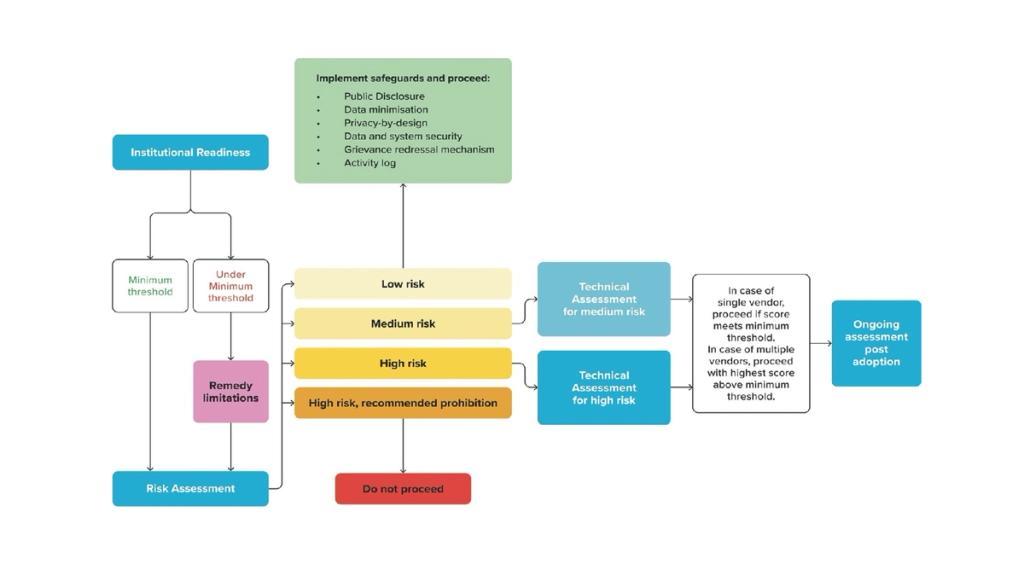
The four assessment tools consist of:
- Institutional readiness: A set of questions to help the court decide whether its current human resources, infrastructure and finance considerations are adequate for the successful design, deployment, and monitoring of AI tools.
- Risk assessment: A mechanism for courts to identify the potential risks of AI use in judicial processes. The assessment will help courts determine whether to proceed with deploying AI for the intended purpose and, if so, with what safeguards.
- Technical Assessment: A detailed vendor assessment questionnaire that systematically examines vendor credentials, technical capabilities, data governance practices, transparency measures, safety protocols, and accountability mechanisms.
- Ongoing assessment: Questions for the court and vendor to continuously monitor the tool’s impact and to determine success metrics once it is adopted.
The toolkit may be used either when a single vendor is under consideration for a particular use case or when the court is choosing among multiple vendors.